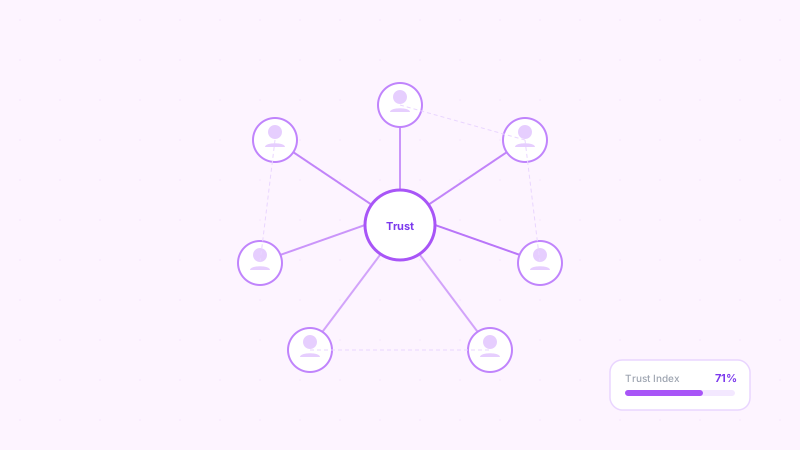
Trust: The Invisible Infrastructure of Teams
In Patrick Lencioni's "Five Dysfunctions of a Team" model, absence of trust sits at the bottom — it's the root of all other problems. But how do you measure trust?
The traditional approach: "How much do you trust your teammates?" The answer to this question rarely reflects actual trust levels.
Behavioral Components of Trust
Research identifies three fundamental behavioral components of trust:
1. Reciprocity
Trust is built through mutual exchange. This is clearly observed in the prisoner's dilemma:
- High trust: A cooperates → B also cooperates → the cycle continues
- Low trust: A starts with suspicion → B reciprocates with suspicion → mutual avoidance
2. Consistency
Trustworthy people exhibit similar patterns across rounds. Inconsistent behavior erodes trust:
- Full cooperation one round, zero contribution the next → distrust signal
- Consistently moderate contribution → reliable but cautious
- Consistently high contribution → trust-building
3. Vulnerability (Risk-Taking)
Making the first move takes courage. "I'll give first, hoping to see it reciprocated" — this is the fundamental act of trust.
In business:
- Sharing an incomplete idea
- Being the first to admit a mistake
- Being the party that puts resources on the table
How Is Trust Measured?
NormSignal tracks these metrics in interactive scenarios:
| Metric | What It Measures | How It's Calculated |
|---|---|---|
| Reciprocity Index | B's response to A's move | Correlation coefficient |
| Consistency Score | Variance of decisions | Standard deviation (low = consistent) |
| First-Move Tendency | Cooperation rate in first round | First round contribution / maximum |
| Forgiveness Rate | Return to cooperation after betrayal | Post-defection cooperation percentage |
Trust Breaking Points
Data shows that trust typically collapses through sudden breaks, not gradual decline:
1. Trigger event: A team member makes a promise and doesn't keep it 2. Initial reaction: Others become cautious (contributions drop 10-20%) 3. Spread: Cautious behavior affects others 4. New equilibrium: Team stabilizes at a low trust level
This process typically completes within 2-4 weeks. Early intervention is critical.
Rebuilding Trust
Research shows trust reconstruction is possible through a "forgiveness spiral":
1. Small risks: Offer low-cost cooperation opportunities 2. Quick reciprocation: Respond immediately to positive moves 3. Transparency: Make processes visible 4. Time: Rebuilding trust takes longer than initial construction
Why Surveys Can't Capture Trust
- Surveys take an instant snapshot — but trust is a dynamic process
- Trust questions are the most susceptible to social desirability bias
- Trust breaking points are detected through between-round changes, not a single survey
To discover the trust dynamics in your team through behavioral data, you can apply for a free pilot.