The Hidden Cause of M&A Failure
Research from McKinsey, Harvard Business Review, and Deloitte paints a consistent picture: 70-90% of mergers and acquisitions fail to create expected synergies.
Financial due diligence is done meticulously. Technology fit is evaluated. Market analyses are prepared. But culture fit is usually a last-minute addition or entirely overlooked.
Why Culture Mismatch Is So Dangerous
The merger of two organizations is essentially the collision of two different "social contracts":
- Decision-making style: Consensus or hierarchical?
- Risk tolerance: Innovative or cautious?
- Cooperation norm: Natural knowledge sharing or competitive?
- Trust structure: Open communication or protective?
Traditional Culture Assessment
Standard M&A culture assessment typically involves:
1. Management team interviews 2. Employee surveys 3. Corporate document analysis 4. External observer reports
Limitations of this approach:
| Limitation | Description |
|---|---|
| Subjective | Interviews depend on personal perception |
| Biased | Social desirability bias in surveys |
| Static | A single snapshot, not dynamic |
| Surface-level | Measures statements, not actual behaviors |
Behavior-Based Culture Mapping
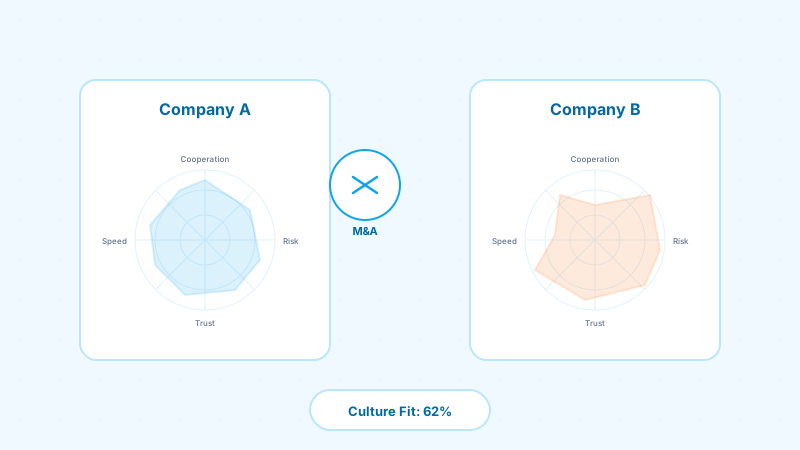
Behavioral data measures culture through actions rather than statements. Two organizations can be compared across these dimensions:
1. Cooperation Profile
Through public goods games, both organizations' metrics are compared:
- Average contribution rates
- Conditional vs unconditional cooperator distribution
- Free-riding rates
2. Trust Structure
Through prisoner's dilemma scenarios:
- Reciprocity levels
- First-move tendencies
- Forgiveness rates
3. Risk-Taking Tendency
Through decision scenarios:
- Average risk-taking level
- Risk-taking variance
- Short-term vs long-term decision profile
Practical Application Scenario
Situation: Company A (100 employees, Turkey) is acquiring Company B (50 employees, Germany).
Pre-M&A Behavioral Analysis:
| Metric | Company A | Company B | Risk |
|---|---|---|---|
| Cooperation index | 62% | 48% | MEDIUM |
| Trust score | 71% | 83% | LOW |
| Risk-taking | High | Low | HIGH |
| Decision consistency | Medium | High | MEDIUM |
Action: A shared decision-making framework should be added to the integration plan to balance risk-taking styles.
Post-M&A Monitoring
After the merger, behavioral metrics are regularly tracked:
- Changes in cooperation index (decline expected, recovery time is critical)
- Trust dynamic breaking points
- Quality of interactions between newly formed teams
To learn more about culture fit analysis in M&A processes, get in touch.