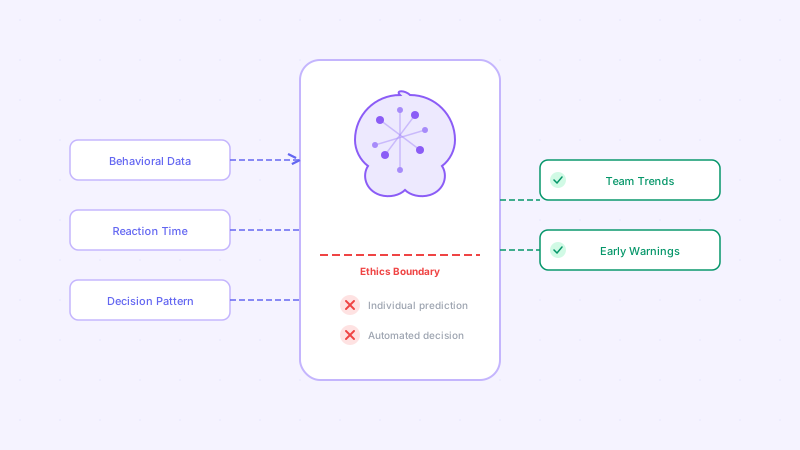
The AI Act and HR Technologies
The European Union AI Act classifies AI systems by risk level. AI applications in employment and workforce management fall in the high-risk category — if they're used as decision-making tools.
This is a critical distinction for HR technologies.
Decision-Making vs Decision Support
| Decision-Making (High Risk) | Decision Support (Minimal Risk) |
|---|---|
| "Promote this employee" | "Team cooperation index is declining" |
| "Eliminate this candidate" | "Risk-taking tendency is high in this team" |
| Assigning performance scores | Presenting trend analysis |
| Automated ranking/filtering | Providing information and context |
NormSignal's Approach: Decision Support Only
NormSignal has been positioned as a decision support tool from its design philosophy. This isn't just a label — it's a reality backed by technical architecture:
1. Individual Output Is Technically Impossible
The system is not designed to produce individual-level reports. The minimum n rule (n≥5) is enforced at the system level — this is a technical constraint, not a policy choice.
2. Trends, Not Scores
NormSignal doesn't say "Ahmed's trust score is 72." It says "There's been a declining trend in trust dynamics in this team over the past 3 weeks." The difference is significant.
3. Context, Not Prescription
Reports don't say "do this." They say "this situation is observed, possible causes could include these." The HR professional makes the action decision.
Bias Risk and Safeguards
Every data-based system carries bias risk. NormSignal's approach:
Design Phase:
- Scenarios are designed to be culture-neutral
- Parameters based on academic literature
- Scoring formulas are transparent
- Aggregate-level statistical checks
- Monitoring for inconsistencies across demographic groups
- Regular calibration reviews planned
- The system doesn't make individual "good/bad" assessments
- When cultural differences create score differences, this is reported as "context," not a "problem"
- Decision-making style differences carry no value judgment
Transparency Principle
NormSignal's transparency commitments:
1. Employees know: What's measured, how it's processed, who it's shared with — clearly communicated 2. Algorithms are documented: Scoring logic is documented with academic references 3. Limitations are stated: Reports always include a "this system cannot do the following" section 4. Audit path is open: All technical infrastructure is ready for independent auditing
The Future: Responsible HR Analytics
The future of HR analytics is not about collecting more data, but about using existing data more responsibly:
- Data minimization principle (collect only what's needed)
- Purpose limitation (collected data used only for stated purpose)
- Time limitation (data deleted after specified period)
- Human-centered design (technology serves people, not the reverse)
To learn more about ethical and transparent HR analytics, get in touch.