Survey Fatigue Is a Real Problem
According to Gallup's 2023 data, only 23% of employees worldwide are truly engaged at work. What tool detects this statistic? Surveys. But how much can we trust surveys?
For years, HR departments have relied on Likert-scale surveys to measure employee engagement, satisfaction, and team dynamics. However, this approach has serious blind spots.
Social Desirability Bias
People, especially in the workplace, tend to give the "correct" answer. Someone who gives a low score to "How much do you trust your manager?" worries that it will somehow come back to them.
Research reveals the scale of this bias:
- 62% of employees admit they don't share their true thoughts in surveys
- Even in anonymous surveys, results converge toward the mean
- Saying "My team collaborates very well" doesn't mean it's actually true
The Gap Between Stated Attitudes and Behavior
This phenomenon, known in psychology as the "attitude-behavior gap," refers to the inconsistency between what people say and what they do.
An employee might say "I find collaboration very important," but in practice:
- Avoids sharing information in meetings
- Reluctantly participates in cross-functional projects
- Uses shared resources for personal benefit
How Does Behavior-Based Measurement Work?
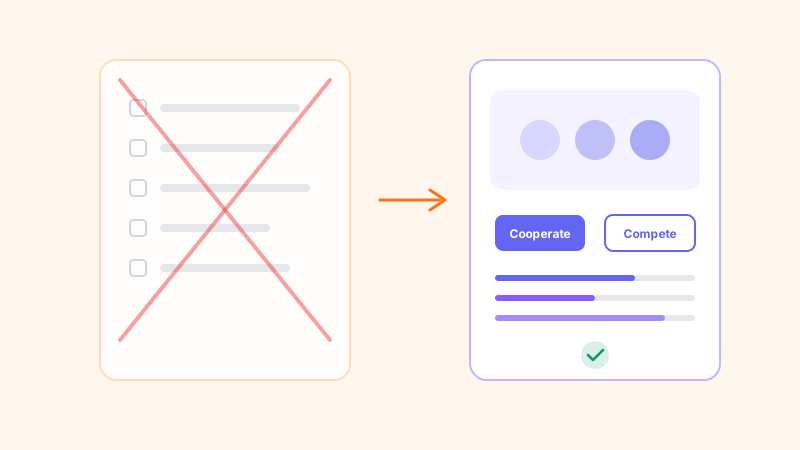
Instead of asking people "what do you think?", the behavior-based approach puts them in real decision situations and observes what they do.
Scenario Example — Public Goods Game:
Your team was given 10 points. How many of these points will you put into the common pool? The total in the pool will be multiplied by 1.5 and distributed equally to everyone.
In this scenario, the person makes a real decision. Saying "I love collaboration" isn't enough — they need to demonstrate it through their behavior.
Key Differences
| Traditional Survey | Behavior-Based Measurement |
|---|---|
| "Do you value cooperation?" | Actual cooperation decisions observed |
| Susceptible to social desirability bias | Bias-resistant |
| Measures statements | Measures tendencies |
| Static snapshot | Dynamic trend analysis |
| Can be manipulated | Manipulation-resistant |
Conclusion
Surveys have their place, but they're not sufficient alone. Behavior-based measurement reveals employees' actual tendencies — not what they say, but what they do.
To discover your team's real collaboration dynamics, you can apply for a free pilot.