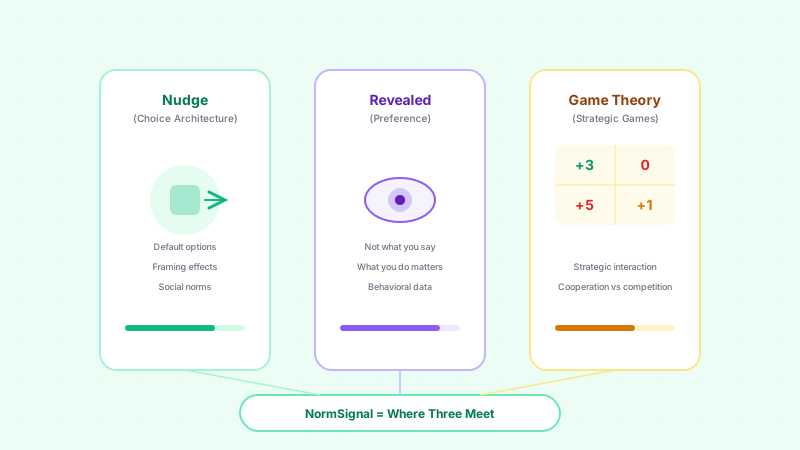
The Behavioral Economics Revolution
When Daniel Kahneman won the Nobel Prize in Economics in 2002, it shook the foundations of mainstream economics: Humans are not rational. Our decisions are subject to systematic biases, heuristic shortcuts, and emotional reactions.
When Richard Thaler won the same prize in 2017, it solidified this revolution: Behavioral insights can be used to "nudge" people toward better decisions.
So how do these findings translate to the workplace?
Key Behavioral Concepts and Workplace Equivalents
1. Loss Aversion
Theory: People feel a loss more strongly than a gain of the same magnitude. The psychological impact of loss is approximately 2x that of gain.
At work:
- Employees resist change — because losing the current state feels more threatening than potential gains
- "The new system is 30% more efficient" is less effective than "the current system wastes 20 hours per month"
- Teams underinvest in risky but high-potential projects
2. Herd Behavior
Theory: Under uncertainty, people imitate others' behavior. "If everyone's doing it, it must be right."
At work:
- One team member starting to free-ride pushes others toward low contribution
- If nobody asks questions in a meeting, asking feels "risky"
- Cooperation norms — good or bad — spread rapidly
3. Anchoring Effect
Theory: The first piece of information encountered disproportionately influences subsequent judgments.
At work:
- The first performance review anchors all subsequent evaluations
- In salary negotiations, the party making the first offer has the advantage
- Once a "this team is problematic" label is placed, it persists even when data shows otherwise
4. Commitment Bias
Theory: The more people invest in a path, the more they tend to continue even when evidence shows it's wrong.
At work:
- Continuing to allocate resources to failing projects
- "We've invested too much to quit now" mentality
- Delayed correction of wrong hiring decisions
The Behavioral Data Difference
Traditional HR approaches try to detect these biases through surveys. The problem: Surveys themselves are subject to biases.
Behavior-based measurement breaks this cycle:
| Bias | Survey Detection | Behavioral Data Detection |
|---|---|---|
| Loss aversion | "Are you open to change?" → Everyone says "yes" | Actual preferences measured in risk-taking scenarios |
| Herd behavior | "Do you think independently?" → Everyone says "yes" | How much does contribution rate converge toward group average? |
| Anchoring | Undetectable | Effect of first-round decisions on subsequent rounds analyzed |
| Commitment bias | Undetectable | Post-feedback strategy flexibility measured |
Nudge: Shaping Behavior
Behavioral insights can be used not only for measurement but for positive change:
1. Defaults: Make participation opt-out instead of opt-in → participation rate increases 2. Social norm display: "78% of your team contributed fully this period" → encourages cooperation 3. Timing: Give feedback at the moment of the event, not 6 months later → maximizes learning effect 4. Simplification: Simplify complex processes → decision quality improves
Ethical Boundaries
The ethical framework for behavioral interventions:
- Transparency: Employees should know how the system works
- Autonomy: Humans make decisions, the system only informs
- Do no harm: Nudges should be in the employee's interest
- Reversibility: Every intervention should be reversible
To learn more about behavioral science-based team analytics, you can apply for a free pilot.