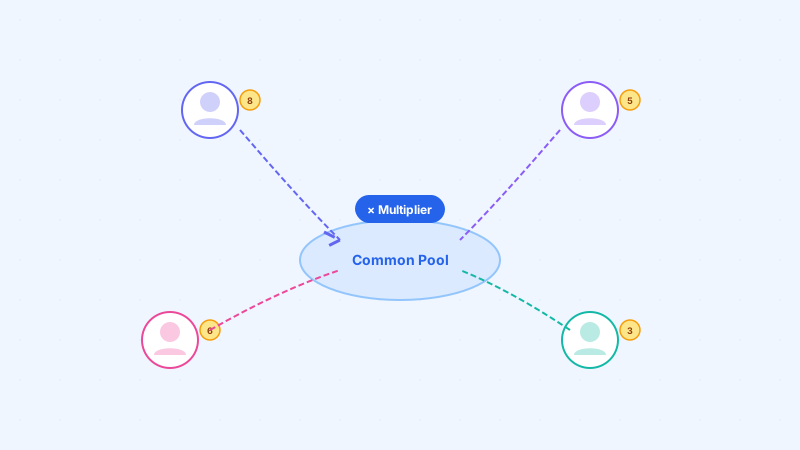
The Common Pool Problem
Imagine a team is given 100 units of resources. Each member decides how much to put into a common pool. The total in the pool is multiplied by a certain factor and distributed equally to everyone.
Mathematically, if everyone contributes fully, total gain is maximized. But at the individual level, the strategy of "I won't contribute, others will" is more profitable in the short term.
This is the fundamental paradox of the public goods game — and a direct model of cooperation problems in business.
Academic Origins
Public goods games have been studied through thousands of experiments since the 1950s. The most impactful findings:
Fehr & Gächter (2000):
- In early rounds, contributions are typically 40-60%
- Contributions decline as rounds progress (free-fall effect)
- Transparency and accountability mechanisms halt the decline
- Approximately 50% of participants are "conditional cooperators" — they contribute if others do
- About 30% are "free riders" — low contribution regardless
- About 20% are "unconditional cooperators" — always high contribution
Translation to Business
| Game Theory Concept | Business Equivalent |
|---|---|
| Contributing to common pool | Knowledge sharing, extra effort, mentoring |
| Free-riding | Relying on others' work |
| Conditional cooperation | "If others work hard, I will too" |
| Punishment mechanism | Transparent performance evaluation |
| Multiplier effect | Synergy — team output exceeds individual sum |
Why Surveys Can't Capture This
Everyone answers "very important" to "How important do you find cooperation?" But a scenario like the public goods game measures a person's actual contribution tendency.
An employee might give a 5/5 cooperation score on a survey but put only 20% of their resources into the pool in a scenario. This inconsistency is direct evidence of social desirability bias.
Conditional Cooperators: The Critical Majority
Fischbacher et al.'s finding is vital for organizations: The majority are conditional cooperators. This means:
- If team norms encourage cooperation → the majority cooperates
- If a few people free-ride → the majority also reduces contributions
- The domino effect is inevitable — in either direction
The NormSignal Approach
NormSignal applies public goods games in a digital environment to measure:
1. Average contribution rate — Team's overall cooperation level 2. Contribution trend — Increasing or decreasing as rounds progress? 3. Conditional cooperation ratio — What percentage of the team are conditional cooperators? 4. Contribution variance — What level of inequality exists within the team?
This data provides much more reliable and actionable insights than survey-based "engagement scores."
To discover your team's real cooperation dynamics through scientific methods, you can apply for a free pilot.