The Real Cost of Turnover
An employee leaving costs between 50-200% of their annual salary. This includes:
- Recruitment and onboarding costs
- Productivity loss (6-12 months for new hire to reach full speed)
- Drop in team morale
- Loss of institutional knowledge
- Risk of disrupted client relationships
Shortcomings of Traditional Prediction Models
Survey-Based Engagement Scores
Typical approach: Run an "engagement survey" 1-4 times a year and calculate a score. Problems:
- Lag: Surveys on 6-month cycles detect problems that have already formed
- Bias: Paradoxically, someone considering leaving may give more positive answers
- One-dimensional: "Engagement" tries to reduce a complex phenomenon to a single number
- Action gap: "Our engagement score dropped" doesn't tell you why
Demographic and HR Data Mining
Another approach: Analyzing structural data like salary, tenure, promotion history. Problems:
- These factors show correlation but don't explain causation
- "An employee who hasn't been promoted in 3 years is at risk" → but what do you do with this?
- Predictive power at individual level is low
The Behavioral Data Difference
The behavior-based approach captures departure signals at the formation stage:
Early Signal 1: Cooperation Decline
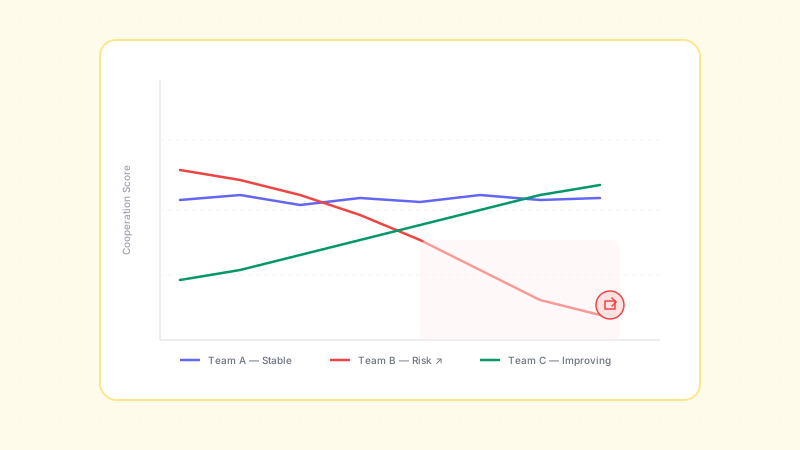
An employee considering leaving unconsciously reduces their contribution to team cooperation. In public goods game metrics, this appears as:
- Contribution to common pool drops below 40% (while team average is 55%)
- Contribution trend negative for 3+ consecutive periods
- Shift from conditional cooperator to free-rider profile
Early Signal 2: Risk-Taking Behavior Change
Someone with departure intent changes their risk-taking behavior as organizational commitment declines:
- Either excessively risky decisions: "I'm leaving anyway" mentality
- Or excessively cautious decisions: "Don't want trouble" approach
- In both cases, decision profile moves outside the normal band
Early Signal 3: Reciprocity Decline
Trust and reciprocity metrics drop:
- Less reciprocation to teammates' cooperation
- "No point investing in the team" feeling reflects in behaviors
Timing Advantage
| Method | Detection Time | Intervention Window |
|---|---|---|
| Resignation letter | Too late | None |
| Annual survey | 6-12 month lag | Narrow |
| Pulse survey | 1-3 month lag | Moderate |
| Behavioral data | 2-4 weeks | Wide |
Ethical Framework
Critical boundaries when using behavioral data for turnover prediction:
1. No individual predictions — NormSignal does not produce outputs like "departure probability 73%" 2. Team-level trend analysis — "Cooperation metrics are declining in this team" observations 3. Decision support only — Data supports the manager's decision, doesn't replace it 4. Transparency — Employees know what's being measured
Conclusion
Turnover prediction isn't about "knowing who will leave" — it's about detecting and solving problems early. Behavioral data provides real-time monitoring of dynamic changes that surveys can't capture.
To monitor cooperation trends in your team through behavioral data, you can apply for a free pilot.