What Is Game Theory?
Game theory is a branch of science that mathematically examines strategic decision-making situations. Founded in 1944 by John von Neumann and Oskar Morgenstern's "Theory of Games and Economic Behavior," it reached its peak with John Nash's concept of "Nash Equilibrium."
So what does this academic concept have to do with business? Much more than you might think.
Teams Are "Game" Fields
Every day at the office, you make dozens of strategic decisions without realizing it:
- Information sharing: Will you share your data with the team, or keep it to yourself as "power"?
- Extra effort: When everyone works at the same level, will you stay there or contribute extra?
- Risk-taking: Will you propose an innovative idea, or conform to the status quo?
The Prisoner's Dilemma: Trust and Cooperation
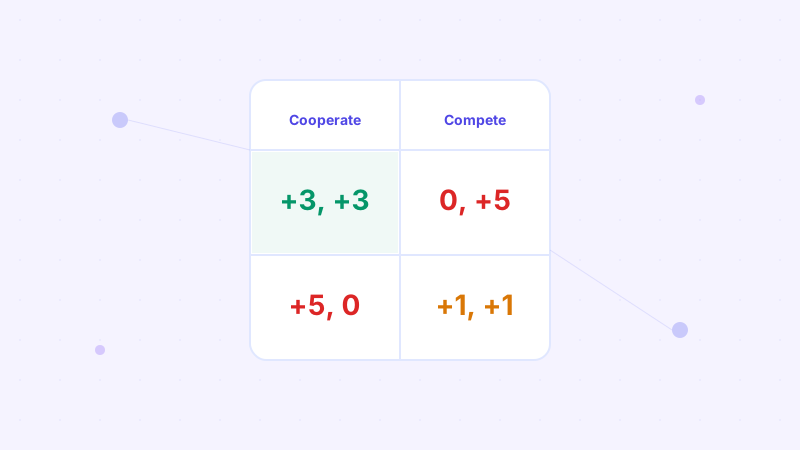
The prisoner's dilemma is the most famous game theory scenario modeling the mutual trust situation between two parties. The best outcome occurs when both cooperate, but there's an individual incentive to "defect."
In business, this looks like:
| Situation | Outcome |
|---|---|
| Two departments share information | Both sides win |
| One shares, the other withholds | The sharer is disadvantaged |
| Both withhold information | Both sides lose |
Public Goods Games: The Free-Rider Problem in Teams
Public goods games examine a group contributing to a common pool that is then shared among everyone. The classic problem: If everyone thinks "others will contribute," the pool empties.
In Fehr & Gächter's (2000) famous experiment, contributions decline as rounds progress — until a punishment mechanism is added. Transparency and accountability are key to sustaining cooperation.
This finding translates directly to business:
- Transparent performance metrics reduce free-riding
- Shared goals prevent individual optimization
- Feedback loops make cooperation sustainable
The NormSignal Difference
Traditional surveys ask "How important is cooperation to you?" Most people say "very important" — because that's the correct answer. But if you don't measure actual behaviors, you can't get beyond social desirability bias.
NormSignal measures people's actual cooperation, trust, and decision-making tendencies through interactive decision scenarios. Not surveys — behavior-based.
To learn more about behavioral science-based team analytics, you can apply for a free pilot.